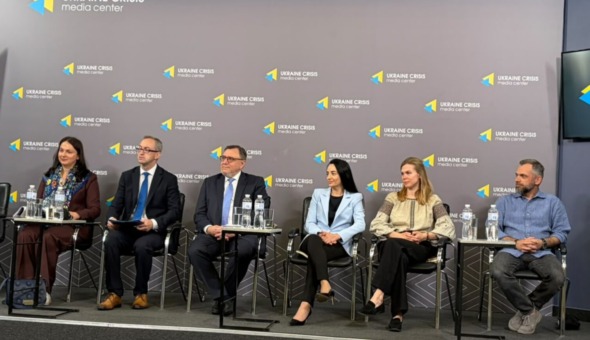
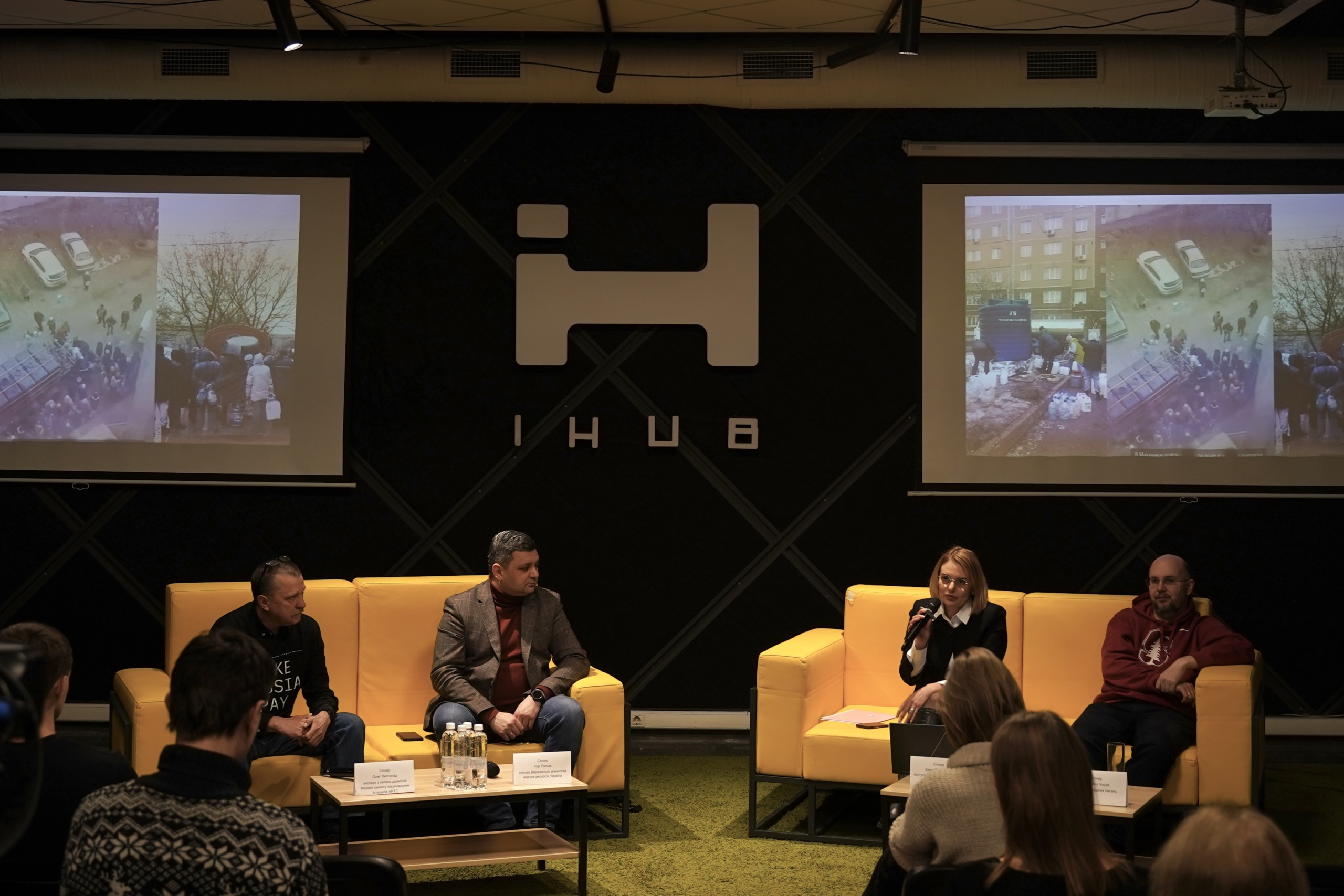
The war has transformed water in Ukraine into a factor of national security: destroyed infrastructure, polluted water bodies, chronic shortages in frontline regions, and—parallel to this—Ukraine’s commitment to aligning its water policy with EU standards. These challenges were the focus of a press briefing in Kyiv titled “More precious than gold: water as Ukraine’s strategic resource on the path to the EU”. The discussion centered specifically on the Donetsk region, where the destruction of pipelines, pumping stations, reservoirs, and treatment plants due to Russian aggression is creating long-term risks for human health and ecosystems. It also addressed the implementation of the EU Water Framework Directive, including river basin management, modern monitoring, and new solutions for preserving river water levels and peatlands.
Donetsk region without water: how infrastructure destruction becomes an ecological crisis
The Donetsk region is a water-scarce, densely populated, and heavily industrialized area. The foundations of its complex water supply system were laid during the Soviet era. Following Russian aggression in 2014, this system began to crumble, and since the start of the full-scale invasion, its operation has become nearly impossible. Beyond the physical destruction of pipelines, the war has triggered another equally dangerous problem: the degradation of wastewater treatment and drainage systems. In an already water-poor region, this means that the volume of polluted discharge sometimes exceeds the volume of natural river water. According to Ihor Hopchak, Head of the State Agency of Water Resources of Ukraine, the agency’s laboratories are already recording the consequences.
“We are already seeing that the content of heavy metals in water bodies—cadmium, lead, mercury—exceeds the norm by up to 10 times; there are also petroleum products and nitrogen compounds. The most dangerous part is that irreversible processes may begin, which will have consequences not only for people but for the entire ecosystem of the region.”
According to Hopchak, the situation is further complicated by the fact that a significant portion of the water infrastructure remains in occupied territory, making an accurate assessment of its condition impossible. Furthermore, even after de-occupation, restoring the water supply will require more than just repairing individual facilities—it will require a complete reconstruction of the entire water management system.
Oleh Lystopad, an environmental expert with the “ANTS” National Interests Advocacy Network, added that most of the water supply system—which included the Siverskyi Donets–Donbas canal, 17 reservoirs, over 60 pumping stations, and nearly 20 filtration stations—has been destroyed.
“The Donetsk water supply system is an incredibly complex infrastructure: part underground, part on the surface. It was severely damaged by Russian shelling, and pumping stations have been destroyed or looted since 2014. This system doesn’t run itself — water must be constantly pumped. When the pumping stations are destroyed, it jeopardizes the water supply for the entire region”.
European water policy standards are impossible without economic mechanisms
Reforms in the water sector are part of Ukraine’s European integration process. This is not only about environmental standards but about changing the entire water resource management model — from planning and monitoring to economic mechanisms that ensure the restoration and preservation of aquatic ecosystems. Ukraine has already taken a number of steps in this direction: the river basin management principle is being introduced, new institutions for land reclamation management are being created, and mechanisms for accounting and protecting natural water reservoirs are being developed, specifically peatlands, which play a key role in maintaining river water levels and preserving climate balance. At the same time, according to Iryna Ovcharenko, Deputy Minister of Economy, Environment and Agriculture of Ukraine, full implementation of European standards is impossible without systemic changes in financing and the economics of water use. The state already has strategic documents and is conducting an analysis of water resource use, but for effective management, it is necessary to create a self-sufficient system that will ensure the restoration of aquatic ecosystems and responsible water use.
“Until there is a self-sufficient system for financing water resource management, we will not have a good ecological and chemical status of water bodies. If we want to have clean water and a healthy environment, water resource management must be supported by economic tools in the same way as it works in European Union countries.”
Ukraine has implemented about 80% of the EU water directive
Water expert Mykhailo Khoriev emphasized that Ukraine’s water policy today is at a stage of systemic change. This is not only about modernizing water resource management but also about adapting legislation to European standards, developing a modern monitoring system, and creating economic mechanisms for responsible water use. According to him, in recent years, Ukraine has significantly progressed in implementing the norms of the EU Water Framework Directive, which was the result of consistent work by state institutions, the expert community, and international partners. At the same time, alongside the issue of water quality, another problem is becoming increasingly acute — the limitation of water resources. In many regions of the country, a water deficit is already being felt, and the uncontrolled construction of ponds and reservoirs only increases the imbalance in river ecosystems. That is why new legislative initiatives must combine environmental requirements, economic incentives, and effective tools for managing water systems. One such tool should be the Law of Ukraine on preserving river water levels and their protection from pollution. Its draft is currently undergoing public discussion. The document provides for amendments to the Civil and Water Codes of Ukraine with the aim of legislative regulation of river basin management plans. Key areas of the draft law:
ecological recovery: implementation of measures to preserve river water levels and protect them from pollution;
European integration: further harmonization of national legislation with European Union law in the field of nature restoration;
free flow of rivers: introduction of procedures for inspection and accounting of hydraulic structures that violate the hydrological regime and the natural state of water bodies.
“It is in the water sector that Ukraine’s movement toward the EU is one of the most advanced. Compliance with the Water Framework Directive currently stands at about 80%. In many other environmental areas, we do not see such progress yet.”
Mykhailo Khoriev paid special attention to the topic of restoring peatlands, which play a critically important role in water balance and climate stability. According to him, for decades, Ukraine carried out large-scale drainage of such territories for agricultural use. However, today it is becoming obvious that peatlands perform a strategic ecological function: they accumulate water, support river water levels, and are powerful natural carbon sinks. An important step for the preservation of peatlands should be a Cabinet of Ministers decree on the special status of these biotopes. As of today, the draft decree has already passed public discussion and is undergoing approval in a number of ministries before being submitted for consideration by the Cabinet of Ministers.