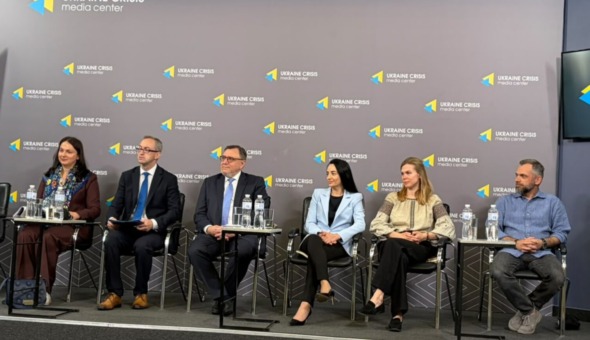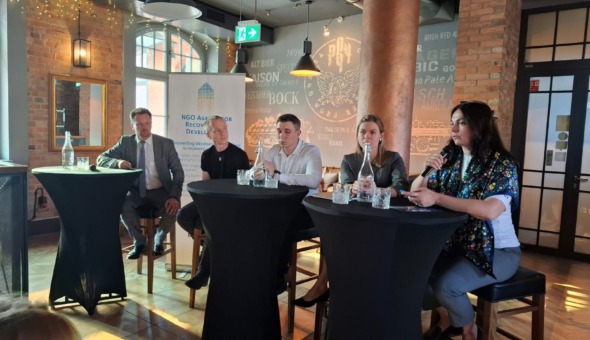
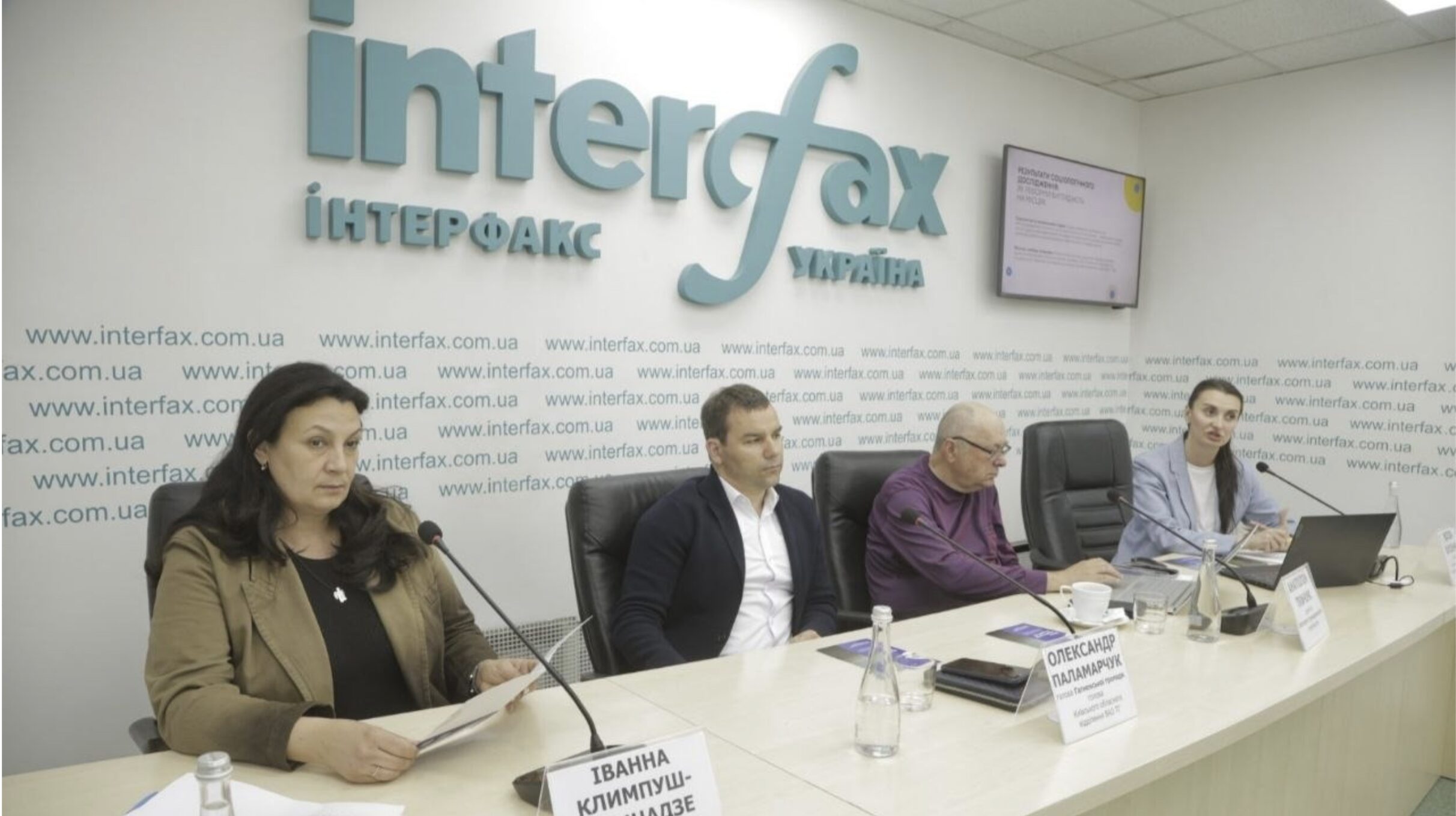
An analytical study presentation titled «Ukraine’s EU Accession in Practice: Sectoral Harmonisation, Regional Implementation, and Public Perception» took place in Kyiv, organised by the NGO «Network for the Protection of National Interests «ANTS». During the event, experts, Members of Parliament, representatives of local communities, and international programmes discussed the actual state of implementation of European reforms in Ukraine, as well as the challenges that could slow down European integration even after the formal opening of negotiation clusters. The study combines legal analysis and sociological research and covers key negotiation areas of Ukraine’s accession to the EU, including energy, social policy and labour market, industrial policy, rule of law, anti-corruption system, security, justice, and border management.
The event moderator, Yuliia Vusenko, Expert on Effective Local Self-Government at the ANTS Network, stressed that one of the key challenges for Ukraine on its path to EU membership remains not only the adoption of the necessary laws, but also the real capacity of state institutions, regions, and communities to implement European rules in practice. According to her, Ukraine is currently going through an exceptionally difficult stage of transformation under the conditions of full-scale war, when the country simultaneously has to ensure security, support community resilience, and adapt to European Union standards.
«Today, it is extremely important that European integration does not remain merely a process of adopting laws. Real integration into the EU begins when communities, businesses, and state institutions are able to implement these changes in everyday life. That is why we need not only formal harmonization of legislation, but also stronger institutional capacity, professional expertise, and the financial resilience of communities», said Yuliia Vusenko.
During the presentation of the study, Member of Parliament of Ukraine Ivanna Klympush-Tsintsadze emphasized that genuine integration into the European Union cannot be reduced solely to the adoption of laws or declarative decisions. According to her, the key challenge for Ukraine lies not only in legislative harmonisation, but also in deep institutional changes that citizens, communities, and businesses must feel in their daily lives.
«We need to move away from associating the adoption of a law with European integration. A law in itself is not yet a reform. Even a perfect law will not work without trained people, without changes in approaches, without institutional capacity, and without real implementation at a level understandable to citizens. If a law remains merely an adopted act that does not change people’s lives, this is a kind of ‘window-dressing European integration’. That is why it is critically important for people to understand how specific changes affect their lives, what benefits they bring, and why these reforms matter», said Ivanna Klympush-Tsintsadze.
She also stressed that support for European integration in Ukrainian society today is largely based on a security-driven choice in wartime conditions, but this trust is not unlimited.
«The public’s trust in European integration has an expiration date — it is a mandate for results. Ignoring this mandate and failing to achieve real European integration is, at the very least, criminal. We must unite the efforts of civil society, government officials, parliamentarians, and international partners in order to turn all these breakthroughs in relations with the EU into real achievements for people, especially against the backdrop of war», she emphasised.
Susanna Dellans, Team Leader for Polaris Programme and SALAR International Representative in Ukraine, shared Sweden’s experience on its path to European Union membership and highlighted the key role of communities in implementing reforms. According to her, European integration becomes successful only when local self-government receives resources, responsibility, and a clear understanding of its role within the system of change.
«When we talk about European integration, I will speak specifically about communities, because this is where reforms become daily practice — or fail to do so. Sweden’s experience showed that adopting legislation alone is not enough. In Sweden, after joining the EU in 1995, the system only started functioning effectively when municipalities received resources and understood their role in these processes. Around 70% of EU legislation is implemented precisely at the local level. Therefore, it is important that all levels of governance are on this «train», stressed Susanna Dellans.
Anatoliy Tkachuk, Director of the Institute of Civil Society, pointed to the contradiction between Ukraine’s current planning system and the European Union’s actual approaches to financing community development. According to him, excessive procedural complexity and the lack of focus on solving concrete problems are already hindering communities’ access to European resources.
«In some areas, Ukrainian legislation is ahead of real life, while in others it is already beginning to slow it down. A development planning system for local self-government was created in line with European standards. But then we created an even more complicated system — integrated development concepts, comprehensive recovery programmes, prospective public investment plans. And now this system no longer corresponds to European financing approaches. The EU does not finance simply the construction of a school or sewage system — the European Union finances problem-solving. In Ukraine, however, everything works the other way around», stressed Anatoliy Tkachuk.
He also underlined that adapting legislation alone will not be enough for Ukraine to receive European funding — it is necessary to change the very approach to governance and thinking.
«The key task today is to see how the entire institutional system can be aligned with accelerated economic growth. Ukraine lacks resources, while the needs are enormous. Partly, this can be addressed through European funding. But to receive it, we must act according to European rules and, most importantly, ‘reprogramme’ our mindset: think in a European way and use European priorities as the foundation. Otherwise, we will not receive this funding», he concluded.
Oleksandr Palamarchuk, Head of the Hatne Hromada and Head of the Kyiv Regional Branch of the Ukrainian Association of Amalgamated Territorial Communities, stressed that support for Ukraine’s accession to the European Union had emerged long before the full-scale war, because Ukrainians saw the standards of living, opportunities, and quality of life in European countries and aspired to become part of this space. At the same time, according to him, European integration is not only about new opportunities, but also about society’s and businesses’ readiness to work according to transparent rules and share responsibility.
«When we become part of the European Union, everyone must understand that this is not only about higher salaries or pensions, but also about a different level of responsibility and taxation. And I can see that small and medium-sized businesses are ready for this. People are ready to work transparently and ready to pay higher taxes, but only on the condition that the rules are equal for everyone and applied equally without exception. Only then will there be fair competition and just conditions for development», he stressed.
He separately emphasized that Ukrainian communities are already demonstrating extremely rapid development even under wartime conditions, and that some practices could also be useful for European partners.
«If someone visited Italy or Spain ten years ago and returned there today, they might not notice much difference. But if you look at Ukrainian communities over the past 15–20 years, changes are happening literally every month. Yes, today there are communities fighting simply for survival because of the war. But at the same time, there are many examples of development, mutual support, and efficiency. And honestly, Europeans also have much to learn from our communities», Palamarchuk noted.
Ihor Krupka, Head of the Analytical Department at the ANTS Network, stressed that the issue of European integration today is directly linked to Ukraine’s resilience during the war, the state’s ability to adapt to new security challenges, and to function effectively in conditions of prolonged instability. According to him, the process of EU accession for Ukraine has long gone beyond a purely political or diplomatic track and has become part of the broader issue of national resilience, economic endurance, and the modernization of state institutions.
«For Ukraine today, European integration is not only about future EU membership. It is also about strengthening the resilience of the state, reinforcing institutions, and ensuring the country’s ability to function effectively in conditions of war and security threats. At the same time, it is important that reforms do not remain merely formal fulfillment of EU requirements, but create real changes for communities, the economy, and the system of public administration», said Ihor Krupka.
The event took place within the framework of the project «Stronger Europe, United Front – Advancing Ukraine’s EU Membership for Greater Resilience and Security», implemented by the NGO “Network for the Protection of National Interests ‘ANTS” with the financial support of the European Union.