Author: Illia Neskhodovskyi, economic expert, ANTS National Interests Advocacy Network. Article prepared for ZN.UA Weekly Mirror.
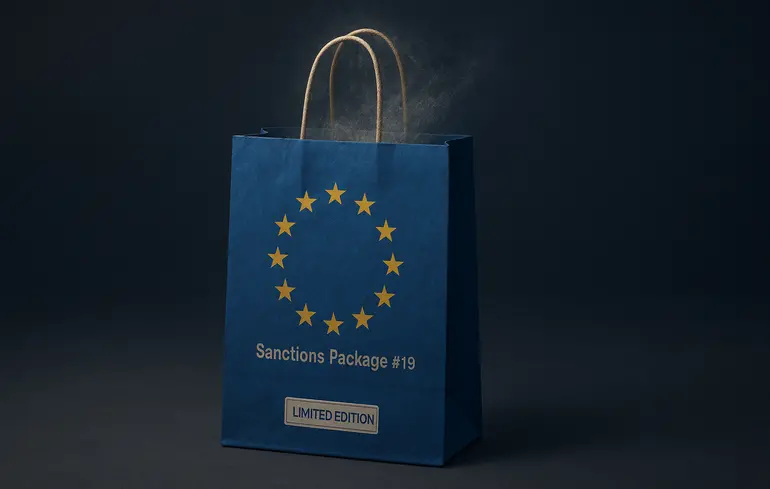
The European Union recently unveiled another sanctions package against the aggressor, which, according to European Commission President Ursula von der Leyen, is meant to exert real pressure. However, a closer look at its content shows that instead of applying the pressure needed to halt the aggressor, the 19th package appears to be a “package of disappointment.” While the steps included are certainly progress, they fall short of the decisiveness required to defeat the aggressor.
Russia is not waging a “war of attrition”; it attacks daily, employing drones and violating airspace. So why is the West responding so timidly, risking that these measures will turn out to be merely symbolic rather than a decisive strike? Unfortunately, the 19th package continues the strategy of gradual pressure, which, as history since 2014 has shown, has failed to prevent a full-scale invasion.
Although the sanctions imposed after the annexation of Crimea led to a 1.4% drop in real consumption in Russia, they did not realize their full potential. Had a complete trade blockade been implemented at the time, Russia’s losses could have increased tenfold, reaching 15% of GDP. This historical lesson demonstrates that a slow, fragmented approach only gave the Kremlin time to adapt and prepare for further aggression.
This indecision is particularly evident in the energy sector, which remains critical to the Russian budget, accounting for roughly 30% of its revenues. Federal budget revenues from oil and gas sales in 2024 rose by more than 26%, reaching 11.13 trillion rubles. While Europe has made significant progress in reducing imports of Russian pipeline gas by 77% between 2021 and 2024, it has simultaneously become the largest consumer of Russian liquefied natural gas (LNG). This paradoxical situation effectively turns European countries into the biggest sponsors of Russia’s war. According to analytics firm Kpler, European countries purchased 52% of all Russian LNG exports in 2024 — approximately 17.4 million tons — with the largest consumers being France (6.3 million tons), Spain (4.8 million tons), and Belgium (4.4 million tons).
Although the new package includes a complete ban on LNG imports, postponing the ban until January 1, 2027 — even a year earlier than originally planned — is not just a sign of weakness; it is criminal indecision, giving Russia ample time to adapt. Instead of delivering an immediate economic blow, the EU is allowing the Kremlin to maintain its highly profitable market and explore new ways to circumvent the ban. Russia is already actively redirecting its export flows, and by 2024, 63% of crude oil exports are expected to be sent to Asia and Oceania, compared to 34% in 2021. Additionally, Russia is using this transition period to build new infrastructure, particularly in the Arctic, and to actively seek new markets in Asia.
The political compromises required to secure unanimous support from all 27 EU member states allow key importers such as France, Spain, and Belgium to adapt their energy infrastructure and find alternative supply sources. Even though the EU is actively ramping up LNG imports from the US, this gradual approach undermines the overall effectiveness of the sanctions and continues to finance Russia’s war.
In addition, it is necessary to target Russia’s “shadow fleet,” which transports oil in circumvention of the price cap. This secret network, estimated to comprise between 940 and 1,400 vessels, was created to evade sanctions. Simply adding ships to the lists, as was done in the 19th package — where 118 ships were added, bringing the total to over 560 — is insufficient, as Russia continues to replenish its fleet. This turns the sanctions process into a “game of tag,” where effectiveness against individual tankers remains low.
Research indicates that 56 sanctioned tankers continued operating, transporting 20 million tons of Russian oil. Secondary sanctions should be imposed on the ports that service them, as well as the insurance companies that cover them. Analysis shows that 57% of Russian oil transported by sanctioned vessels was delivered to just five key ports in India (Sikka, Vadinar, Mundra) and China (Lianqiao, Dongjiakou).
While most EU countries have reduced their imports of Russian oil, some remain key consumers. In particular, Hungary and Slovakia, which receive Russian pipeline oil via the southern branch of the Druzhba pipeline, are exempt from EU sanctions.
In August 2025, Hungary paid Russia €416 million for fossil fuels, of which €176 million was for crude oil. During the same period, Slovakia imported €276 million worth of oil and gas, with 74% of this amount (€204 million) being oil supplied via the Druzhba pipeline.
Despite having the technical capability to diversify supplies, these countries are resisting politically, citing higher costs and concerns about energy security. This underscores the need to increase pressure on them to end their dependence on the aggressor’s energy resources. At the same time, it is worth noting that in April 2025, the Czech Republic completely abandoned Russian oil, switching entirely to supplies from Western routes. This example demonstrates that a full transition is achievable.
Ukraine stopped the transit of Russian gas through its territory on January 1, 2025, yet continues to transit Russian oil via the Druzhba pipeline, contrary to its national interests.
Financial isolation must be complete. Initially, only seven Russian banks were excluded from the SWIFT system, allowing giants such as Gazprombank to remain connected to facilitate payments for gas and oil. There should be no exceptions. Combined with restrictions on cryptocurrency platforms that Russia uses to circumvent sanctions, such measures could effectively paralyze international transactions.
For example, the Russian crypto exchange Garantex continues to operate despite being on the US blacklist, because its servers are located outside US jurisdiction. Adding dual-use companies and technologies to sanctions lists is a step in the right direction, but these measures must be accompanied by strict secondary sanctions against any countries that assist the Russian military-industrial complex.
Exports of electronic components from the United Arab Emirates to Russia, for instance, increased more than sevenfold in 2022, reaching nearly $283 million. Russia skillfully exploits the reluctance of third countries to face strict secondary sanctions from the West, while reaping the benefits of continued cooperation.
The 19th package of sanctions is a step in the right direction, particularly regarding restrictions on LNG, cryptocurrencies, and dual-use technologies. However, it still suffers from fragmentation and strategic gaps. While the West acts gradually, the Kremlin gains time to adapt and find new ways to circumvent the sanctions.
These findings align with the analysis presented in a recent policy paper by the ANTS National Interest Advocacy Network, “Strategy for Victory through Increased Sanctions Pressure on Russia,” which outlines seven key measures to achieve Russia’s complete economic isolation.
Among these proposals are the full disconnection of all Russian and Belarusian banks from SWIFT; the introduction of secondary sanctions against ports serving the “shadow fleet” and the insurance companies covering them; a complete embargo on Russian LNG without any transitional periods; and the systematic dismantling of “parallel import” channels through strict secondary sanctions against intermediary countries.
Additionally, the paper proposes confiscating frozen sovereign assets to finance Ukraine’s reconstruction and aggressively lowering the oil price cap to a level below production costs.
True victory in this economic war requires maximum political will and a coordinated, simultaneous strike on all financial, energy, and logistical arteries of the Russian regime. The West must move from a strategy of containment to a strategy of decisive economic defeat.